
Building a Career as a Founding Product Designer
An interview with Dan Tase, founding designer and startup advisor.
We speak to Dan Tase, a founding product designer who's spent the past few years working exclusively with early-stage startups. From zero-to-one builds to post-launch growth, Dan has helped companies like Jetty and Liftoff shape their products from the ground up.
The Shift to Startups
Dan's design career spans two decades, starting with graphic design gigs in high school and evolving through UI/UX roles at companies like Farfetch and Fresha. But despite successful stints in leadership at larger organisations, something was missing.
Three to four years ago, Dan made a deliberate choice: go all-in on startups and work exclusively as a founding designer. Either with founders bringing an idea to market, or teams that had shipped something and needed to find product-market fit or grow further.
"I act as the founding designer for early-stage teams, tackling the full spectrum of the product development process: research, strategy, product design, brand design, marketing design – honestly, whatever is required from a design perspective and sometimes beyond."
Two Founding Designer Projects
Jetty is an AI companion for people with autoimmune conditions. Dan joined when it was just an idea, two founders with snippets of a concept around symptom tracking. The first three months involved figuring out the entire product, from AI interaction patterns to branding and tone of voice. The app launched a few months ago.
.gif)
Liftoff is a hiring and networking platform that connects great people to opportunities, used by companies like Ramp, Granola and others. Dan's role here was different: less zero-to-one, more about product-market fit and growth for coming out of stealth in October.
.gif)
Finding Founding Designer Roles
Dan's honest about how he's landed projects:
"I don't think I ever got a project through applying."
His approach centres on intentional networking, but not the traditional designer-to-designer variety. Instead, Dan suggests going beyond the design bubble, talking to indie developers, engineers, startup founders, and VC funds. "Most projects I’ve landed in the past few years didn’t come from designers. They came through an engineer or a founder who recommended me to another founder, and it kept going from there."
The timeline matters too. "I talked to people years ago, where nothing came of it. Then, a few years later, they reached out again, needing help. You're just planting seeds, and eventually something grows."
Dan also emphasises helping others. "In scenarios where projects aren't suitable for me, I'll recommend someone else who'd be a better fit. A few years later, that same founder might come back with a different opportunity. Things tend to come back around."
.png)
The Many Hats of a Founding Designer
The skillset between a senior designer at big tech and a founding designer might be similar, but the day-to-day is fundamentally different.
"As a founding designer, especially in zero-to-one work, you're constantly generating. Most of the time, you don't know what you're building yet. The expectation is to generate a dozen ideas quickly, design them, prototype them, and test them. If none stick, you do it again the next day, and the day after that."
A typical designer might find this frustrating. A founding designer gets energy from it.
The generalist nature extends beyond design. At Liftoff, Dan did marketing design because he understood the platform better than any external hire would. At Jetty, he took on branding. He's done sales outreach to prospects he thought would be strong fits. He's done fundraising, not just pitch decks, but talking directly to investors and making introductions.
"You do whatever's needed for the business to grow."

The Steepest Learning Curve
Launch days stand out as particularly intense moments.
"You work for months or years on something, and then it's live. There's real pride in that. But the weeks leading up to launch, and the weeks after, are incredibly demanding."
Everything needs to come together for launch, and once it's live, you're moving fast to address what emerges. Something always goes wrong.
Beyond launches, the daily reality is challenging. "In a start-up, you’re essentially hitting your head against the wall numerous times a day trying to find a way through. It requires a certain type of person to be able to go through that."
Dan's done his best career work with startups, but acknowledges the trade-off: "It's intense. There are very intense periods. You're working through ambiguity constantly, which can be hard. But that's also where the best work happens."
Working with Founders
Startups are intimate businesses. Unlike larger companies, you're working closely with maybe two people early on, and perhaps ten after a year if things go well.
"It's like a family. You're spending eight hours a day with these people. It starts to feel like friendship, especially in longer-term partnerships."
The relationship dynamic is crucial. "You're not just working with a founder, you're working with a friend who's also a founder and your boss. You're there to support them, and they support you; it's an equal relationship."
Communication and reliability solve most problems. "The most important component is being reliable and clearly communicating what's happening. If you consistently do what you say you'll do and communicate clearly, things work out."
Dan also emphasises chemistry. "Over time, you develop a sense for when something's off. I've been in a project where after a month, I could tell the chemistry wasn't there, and we decided to part ways. I've also stayed in projects for years and felt as energized as I did on day one."
The Reality of Working Hours
The startup world does require hard work, but Dan pushes back against performative overwork culture.
"You are going to work hard. But I don't think the norm should be working crazy work hours."
A typical day involves eight focused hours, but the work extends beyond that. "Sometimes at 11 pm the last thing I do is check messages to unblock an engineer."
What makes it sustainable is genuine enthusiasm. "I wake up in the morning excited about the work I have to do. It's just fun."
The key insight:
"You can't compete with someone who's having fun."
Advice for Aspiring Founding Designers
Dan's guidance is practical and grounded in experience:
Figure out if you actually want this. Being a founding designer is different from being a designer in big tech. If you're frustrated with how things work at large companies or you've dreamed of building your own company, you might be suited for this. If you're happy in big tech, stay there. Neither choice is right nor wrong.
Put yourself out there. Tell people you're looking for this specific type of role and why you'd be good at it. Network beyond the design bubble, talk to engineers, founders, VCs, and indie developers.
Be selective about projects. "Startups are so intense that I would struggle to spend a year working very hard on something I don't believe in or with people I don't like. It's slightly easier to coast in a 500-person company because you have a ton of other side benefits to make you happy. In start-ups, personal alignment becomes crucial."
Help others along the way. Recommend people for roles that aren't right for you. Plant seeds without expecting immediate returns. Good karma has a way of coming back.
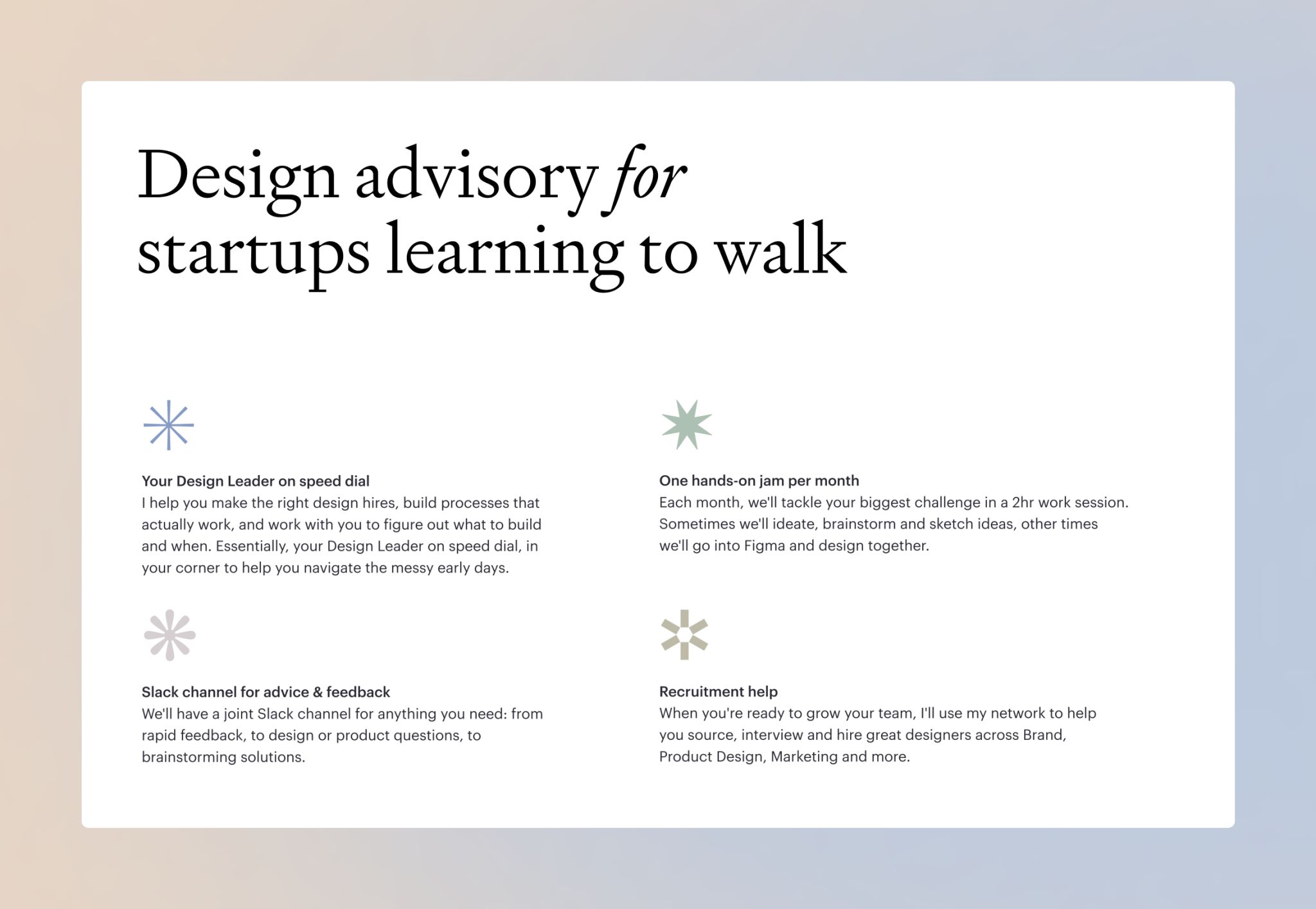
Dan is currently working with Liftoff full-time whilst acting as a “design leader on speed dial” and advising startups on building design teams and scaling the business. And yes, he's eventually planning to move back to London.
For designers considering the founding designer path: it's demanding, unpredictable, and requires genuine passion for what you're building. But for those who thrive on ambiguity and get energy from the zero-to-one process, it can be the most rewarding work of your career.
About Dan:

Dan is a founding product designer and startup adviser based in Sweden (soon London). With 20 years of design experience spanning graphic design, UI/UX, and product leadership at companies like Farfetch, Dan has spent the past few years working exclusively with early-stage startups as a founding designer. He's helped companies like Jetty and Liftoff build their products from scratch and navigate the path to product-market fit.
Follow Dan on LinkedIn and check out his portfolio.